At the MGMA Annual Conference, Mike Sisti, Administrative Director of Managed Care at Silver Cross Hospital, was joined by Darshan Bachhawat, Chief Revenue Officer of Phamily, to present a surprising new path to financial stability in an increasingly unstable market.
Healthcare is at a crisis point. Long-term macroeconomic factors like rising costs and declining reimbursements have collided with new volatility in the form of supply chain disruption, emerging tech competitors, the growing risk of cyberattacks, rising inflation, and legislative upheaval. The biggest impact from the Medicaid cuts written into the One Big Beautiful Bill Act (OBBBA) will start impacting hospitals and health systems in earnest in 2027, with rural areas facing a ~$137B reduction in spending over the next decade.
Today’s healthcare executives are facing converging challenges from all directions, but the outcomes are the same across the board — systems already running on razor-thin margins need to find new ways to cut costs or increase revenue (and fast!) if they want to survive.
We polled attendees at the 2026 MGMA Annual Conference to learn how their organizations are addressing financial uncertainty today. We found that the majority of respondents are looking to payers to plug the gaps with more favorable terms, while some are restructuring vendor contracts or considering layoffs.


One study found 446 hospitals were at heightened risk of closure from OBBBA, and 8% of our polled organizations admitted that consolidation or acquisition were under consideration. Becker’s tracked 44 hospitals that closed departments and ended service lines in the first half of 2026, but the grim truth is that the average hospital, already running at a negative operating margin, cannot cut its way out of a projected net patient revenue decrease of 2-10%.
Instead of more cuts, what hospitals and health systems desperately need is a new source of revenue. And what Silver Cross learned was that Centers for Medicare & Medicaid Services (CMS) has already provided it in the form of Advanced Primary Care Management (APCM).
APCM is not just another point solution. CMS has been clear their intention is to “re-imagine and improve the relative valuation of primary care services,” (2027 PFS) and APCM is a direct result of that vision. Between-visit care management improves outcomes and lowers total cost of care, which are two of CMS’s stated goals, but historically care management programs have been too expensive and time-intensive to build successfully at scale.
APCM reimagines how health systems provide care management by expanding patient eligibility and reducing billing requirements, removing historic blockers to delivering population-scale between-visit care.

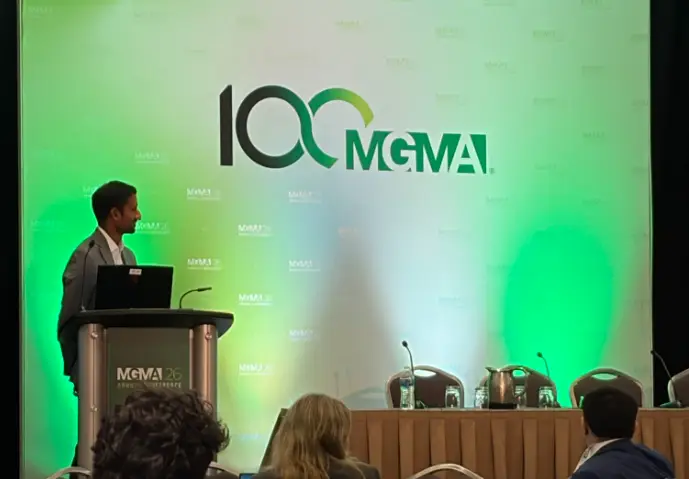
Photo: Mike Sisti, Administrative Director of Managed Care at Silver Cross Hospital, speaking on “Health Uncapped”.
CMS intends to move providers toward wraparound primary care delivered automatically to all patients. Smart health systems will use APCM’s fee-for-service reimbursement today to fund the infrastructure and investment in patient relationships that value-based contracts will require in the future.
When polled, we found the majority of MGMA attendees weren’t running any kind of care management program. And 60% of those that were had less than 1,000 patients enrolled. Almost nobody was running care management at the scale CMS envisioned.
The truth is, successfully scaling care management is hard. Margins are razor-thin, with most care management programs regularly running into the red, making between-visit care a precious resource reserved for only the neediest patients.

per 10k Medicare patients
APCM was designed to increase care manage capacity and help programs grow. That’s not only good news for patients, it also provides a reliable source of significant new revenue, without requiring prohibitive upfront investment, staffing, or training. Health systems can finally get paid fairly for the work they’re already performing.
per 10k Medicare patients
patient retention rate
post-discharge coverage
PPPY reduction in total cost of care (TCoC)
annual operating income — and growing

patient retention rate
post-discharge coverage
PPPY reduction in total cost of care (TCoC)
annual operating income — and growing
In our session, Michael Sisti shared how Silver Cross Hospital, an independent system in a crowded Chicago-area market, grew from 2,000 chronic care management patients to 27,000 enrolled patients in just nine months. Their patients get personalized support from dedicated care teams, backed by the physicians and APPs they know and trust, and the program is delivering for patients and providers alike.
At Silver Cross, care management generates net operating income, reduces total cost of care, keeps patients in-network, and lets clinical staff work at the top of their license. By activating their full patient panel, even those without multiple chronic conditions, Silver Cross is able to go above and beyond in care delivery — closing gaps, addressing Social Determinants of Health (SDOH), and ensuring that when patients do need care, they are seen at the most appropriate site of service.
It’s a model other health systems can (and should!) emulate. Mike Sisti goes into more detail on Silver Cross’s story in our case study and on-demand webinar. To learn how you can evaluate and implement APCM at your own hospital or health system, download our whitepaper.
Help us learn more about the challenges facing today’s healthcare organizations by answering three quick questions.
Respondents will get:
Share your feedback today and discover what a profitable, proactive care management program could look like at your organization.