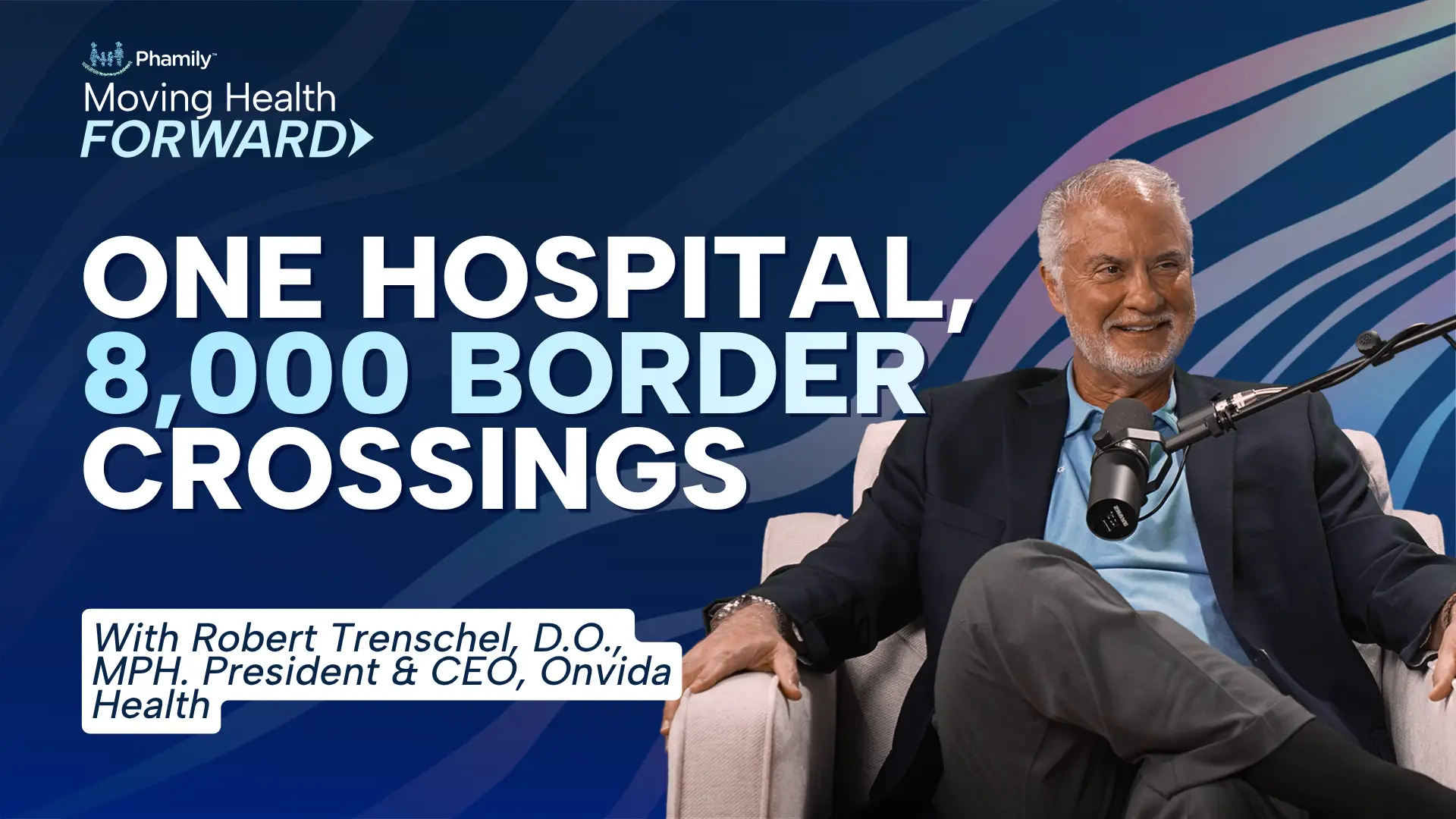
Onvida Health in Yuma, Arizona is the only hospital within 180 miles of the US-Mexico border, and a migration surge once sent 8,000 people a day through its doors. Robert J. Trenschel, DO, MPH, President and CEO, leads a system that treats every patient with the same compassion, from long-time residents to someone just crossing the border.
In the latest episode of Moving Health Forward with Phamily Chief Medical OfficerUmair A. Shah, MD, MPH , Dr. Trenschel talks about the challenges of doing the right thing in a time when health systems like Onvida are under constant financial pressure.
Dr. Trenschel explained the “huge emotional and clinical burden to the hospital” with a story about a pregnant mom who came to the hospital to give birth. Her baby needed care in the NICU, because she had not been able to access prenatal care.
“So that baby's in the NICU. You discharge mom. Where does mom go? We gave mom a bed in the hospital. She stayed in the hospital with the baby because that's the right thing to do. That's one of our core values. We'll always do the right thing.”
— Robert J. Trenschel, DO, MPH
But Dr. Trenschel went on to explain the very real cost of doing the right thing in a highly challenging economic environment. “But this is what people don’t understand in terms of what happens to individual communities… you’ve got this huge influx of individuals. We’re doing everything, and we’re going to continue to do that. But there were no resources on the back end.”
He and Dr. Shah cover navigating that surge on razor-thin margins, why healthcare ROI should center on the individual, and how a new medical school partnership aims to rebuild rural primary care.
The whole conversation is available now.
What we cover:
Running the only hospital within 180 miles of Yuma
Absorbing 8,000 daily border crossings during a migration surge
Standing up a transitional care program for chronic disease patients
Using AI ambient documentation to reduce physician burnout
Partnering with the University of Arizona on a three-year medical school